· FSharp WasmGC Team · Technical · 3 min read
Why WebAssembly GC Is the Right Target for F#
A technical deep dive into how WasmGC's type system aligns with F# semantics — and why compiling F# to WasmGC produces cleaner output than any JS-based approach.
Why WebAssembly GC Is the Right Target for F#
WebAssembly GC (WasmGC) is the most significant evolution in the WebAssembly specification since its initial release. It adds first-class support for garbage-collected heap types to the Wasm type system — and it changes everything about what is possible for functional language compilation to the browser.
This post explains why WasmGC is not just a good target for F# — it is the right target.
The problem with JavaScript-based transpilation
Most “compile F# to the browser” approaches today go through JavaScript. Fable itself targets JavaScript. While this works remarkably well, it has inherent limitations:
- No type information at runtime: JavaScript erases types. F# discriminated unions become plain objects with a
tagfield. Pattern matching becomes if-else chains operating on untyped values. - Boxing overhead: F# value types like
intandfloatget boxed when stored in generic containers likeList<'T>. - No control over memory: The garbage collector is JavaScript’s, not the application’s. You cannot reason about allocation pressure programmatically.
- Runtime bloat: Most F#-to-JS compilers need a runtime library to emulate F# semantics.
WasmGC solves all of these problems at the specification level.
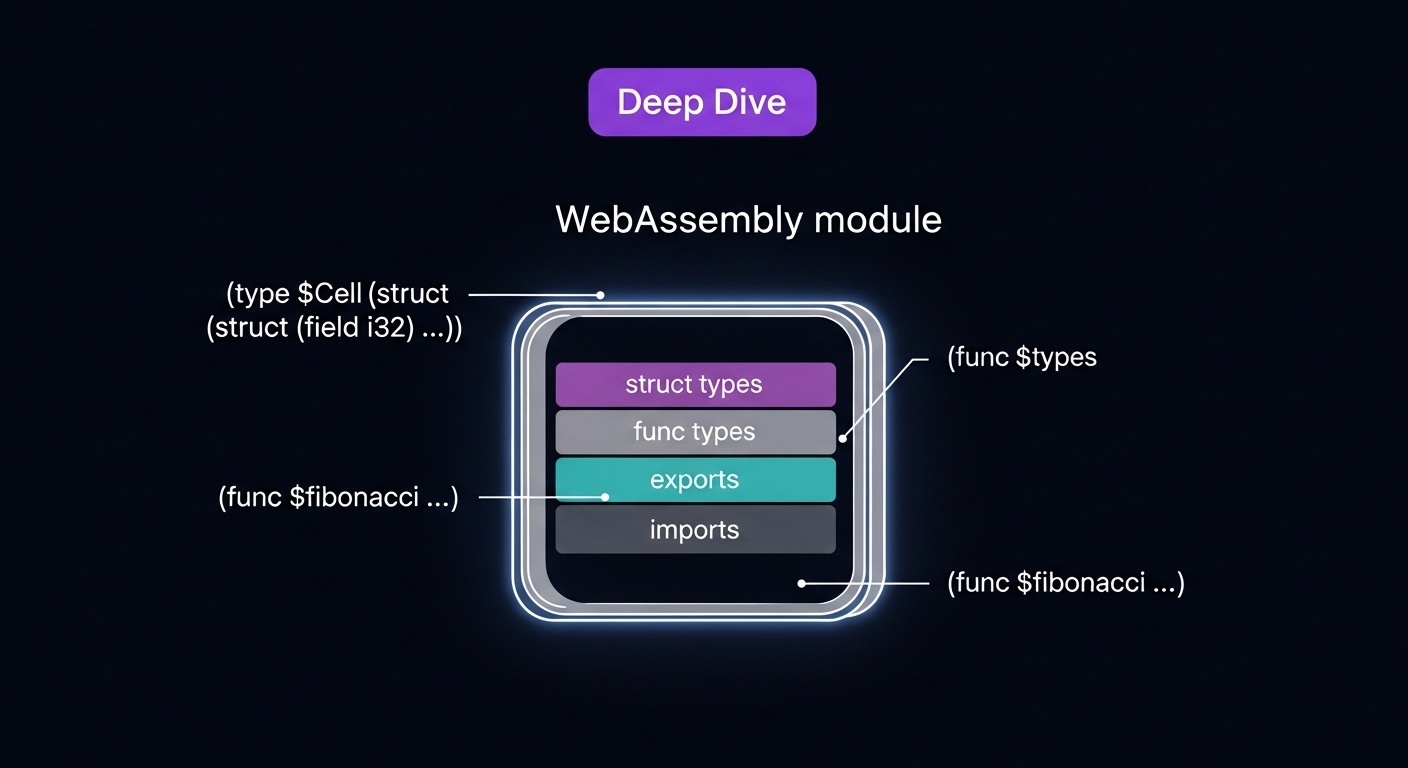
How WasmGC types map to F# constructs
Records → Struct types
F# records are immutable product types:
type Point = { X: float; Y: float }In WasmGC, this becomes a struct type:
(type $Point (struct
  (field $X f64)
  (field $Y f64)
))
The mapping is direct. No boxing, no object, no tag field. Just a typed struct.
Discriminated unions → Struct hierarchies
F# discriminated unions are sum types:
type Shape =
  | Circle of radius: float
  | Rectangle of width: float * height: float
WasmGC supports abstract struct types and concrete subtypes:
(type $Shape (struct))  ;; abstract base
(type $Circle (sub $Shape (struct (field $radius f64))))
(type $Rectangle (sub $Shape (struct (field $width f64) (field $height f64))))
Pattern matching compiles to ref.test and ref.cast — typed, zero-overhead dispatch.
Closures → Typed function references
F# closures capture their environment. WasmGC gives us funcref and typed function references (ref.func). A closure becomes a struct pairing a function reference with its captured environment:
(type $Closure_int_int (struct
  (field $env (ref $SomeEnv))
  (field $fn (ref $FnType_int_int))
))
No boxing, no dynamic dispatch overhead, no indirection through a JavaScript object.
Lists → Linked structs
let xs = [1; 2; 3]Compiles directly to a chain of WasmGC structs: a nil sentinel and cons cells with typed fields. No JavaScript arrays, no runtime list class.
The result
The output of FSharp WasmGC is:
- Smaller — no runtime library, no JS emulation overhead
- Faster to start — no JS parsing or JIT warm-up for the runtime layer
- More predictable — GC behavior is defined by the Wasm GC, not a hidden V8 heuristic
- Type-safe at the Wasm level — the Wasm type system tracks F# types
We are still early in development, but even now our QuickTest suite shows that idiomatic F# compiles cleanly to idiomatic WasmGC — structure preserved, semantics respected.
What’s still to solve
WasmGC is not a silver bullet. Open challenges include:
- Generics: F# generics require either monomorphization or a vtable dispatch strategy. We are implementing fat-pointer vtables.
- BCL coverage: The .NET Base Class Library is enormous. We are building a minimal WasmGC BCL from scratch.
- Interop: Calling JavaScript from WasmGC and vice versa still requires care. We use
[<Import>]attributes for explicit, safe FFI.
These are engineering challenges, not fundamental mismatches. The type system alignment is sound.
Try it
The project is on GitHub. The getting started guide is available in the docs. We welcome contributors, bug reports, and discussions.